Is Casual Dress Killing Your Productivity At Work?
What do people wear at your office? Chances are jeans, casual t-shirts/shirts or sweaters dominate the culture. Of course, certain industries require you to dress up, but a large majority of companies have embraced casual attire.
SAN FRANCISCO, CA - SEPTEMBER 22: Facebook CE...
Facebook CEO Mark Zuckerberg delivers a keynote address during the Facebook f8 conference on September 22, 2011 in San Francisco, California.
And, if you’re among the one-in-four telecommuters, you probably don’t wear a suit when you work from home.
So if you wear a t-shirt and jeans at work…and a t-shirt and jeans on the weekend, can you differentiate between your “work self” and “weekend self?” Does it mean you’re in work mode 24/7? Or conversely, are you likely to always be in play mode finding it harder to be productive?
Dressing casually could cause an employee to feel less focused and alert says Dr. Karen Pine, professor of psychology at the University of Hertfordshire and fashion psychologist.
“When we put on an item of clothing it is common for the wearer to adopt the characteristics associated with that garment. A lot of clothing has symbolic meaning for us, whether it's 'professional work attire' or 'relaxing weekend wear', so when we put it on we prime the brain to behave in ways consistent with that meaning."
It's the reason why we feel fitter in our sports clothes, or more professional in work wear, she adds.
Research shows your alertness is affected by what you wear. This study found that people wearing a doctor’s lab coat displayed heightened attention. When the same people then wore an identical coat, but told it was a painter’s coat, they weren't as attentive as when they wore (what they perceived to be) the doctor's coat. The research found: “The influence of clothes thus depends on wearing them and their symbolic meaning.”
“This theory supports the notion that we would stay more focused when wearing work clothes, and may be more cognitively alert than if we dressed down,” adds Dr. Pine.
But that doesn’t necessarily mean companies should switch back to old world corporate culture to boost productivity. “Although one could draw conclusions from the enclothed cognition study, the studies that actually assess the direct relationship between the two are based on self-report. There’s no absolute scientific study to prove that attire impacts productivity,” says Dr. Jennifer Baumgartner, psychologist and author of "You are what you wear."
“So much of it depends on your gender, your age and your job title. It’s very individualistic.”
Subtle dress changes to bump up productivity
Many companies, particularly in tech, insist on employees dressing down, to cultivate a casual work culture. For some workers, wearing the same type of clothes in and out of the office is troublesome. It becomes hard to distinguish between their “work” and “off work” selves.
What can you do to help you make that distinction?
“People can dress up in a way that still promotes their company’s culture and brand. You can take a creative approach to dressing in 'work' mode, even if you’re wearing jeans,” she says.
Wearing a dressier shirt with customized buttons or cufflinks is one way for men to dress up jeans. Women have a multitude of options – picking fancier shoes or accessories – for example. Experimenting with outfits that help you feel more focused is key.
Creating boundaries to get you out of work mode
If you feel constantly stressed because you're never dressed for 'off duty', Baumgartner emphasizes forming a post-work ritual to decompress. Have a daily activity that signals a change when you come back home.
“Changing your outfit after work is a concrete representation that you are not in work mode any more.” Even if you change out of one pair of jeans into another. Going for a walk, working out or taking a shower are activities that work for others.
“The days I don’t change my clothes after work, I find myself more agitated and find it harder to put down work,” Dr. Baumgartner says. Digitally we’re always plugged into work, so those boundaries have become more necessary than ever.
10 Unexpected Ways Your Clothes Can Change Your Mood
Your clothing can make you feel powerful
 ISTOCK/MEDIAPHOTOS
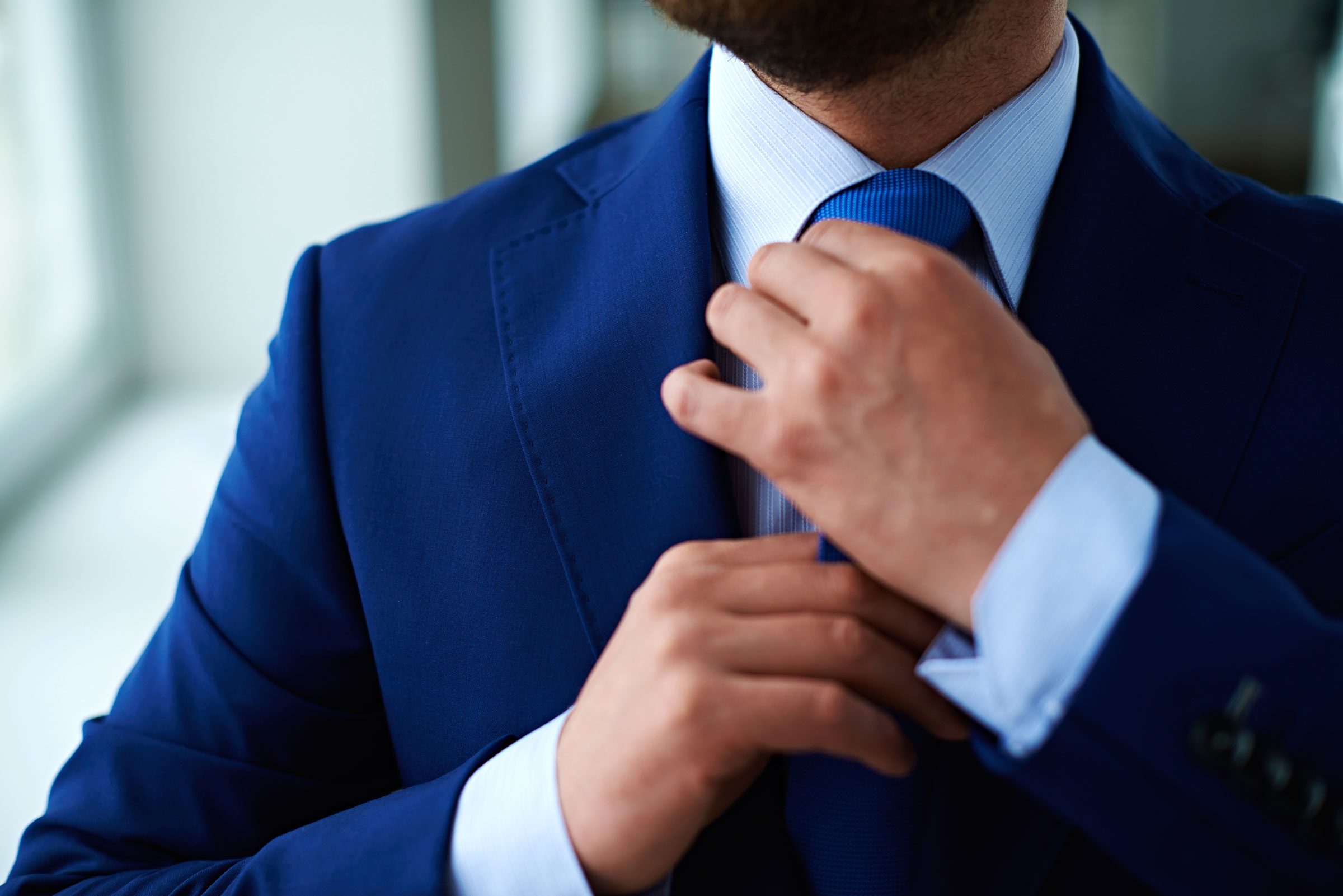
The “power tie” is a real thing, according to a study published in Social Psychological and Personality Science. Researchers had certain people wear formal business attire and complete a series of five experiments that challenged their cognitive processing abilities. Those who dressed up felt significantly more powerful and in control of the situation than their under-dressed peers.
Your clothing can make you a better thinker
 ISTOCK/PEOPLEIMAGES
In addition to feeling more powerful, the study also found that the subjects who dressed in business formal clothing could think faster on their feet and had more creative ideas. The scientists speculated that how you dress can change your perception of the objects, people, and events around you—sparking fresh ideas and a new point of view.
Your clothing can make you exercise harder (but make it feel easier)
 ISTOCK/VADIMGUZHVA
Athletes in red clothing won more events in the 2004 Olympic games than their competitors in blue, which inspired researchers to see if that was just a coincidence or if there is something special about the color red. The study, published in the Journal of Sport and Exercise Psychology, found that people who exercised in red could lift heavier weights and had higher average heart rates, indicating they were working harder than those wearing blue, even though both groups reported similar rates of exertion. But before you toss all your blue workout gear, know that the researchers did not find that the red-clad sportsmen won more often. Find out here what else your outfit color says about you.
Your clothing can make you smarter
 ISTOCK/SCUKROV
Dressing in clothing that is associated with intelligence, like doctor’s coats or pilot’s uniforms, may not only make you look smarter but may actually make you act smarter too, according to a study published in the Journal of Experimental Social Psychology. Researchers gave doctor’s lab coats to subjects (none of whom were doctors) and then asked them to perform a series of complex tasks. Those in white coats made significantly fewer mistakes than the people in their street clothes. The scientists then repeated the experiment but this time gave lab coats to all the participants. However, they told half the people they were doctor’s coats while the other half were told they were paint smocks. Again, the people in the “doctor’s coats” performed better on the tests, which shows that it’s not just what you wear but also what you think of what you wear that matters.
Your clothing can make you focus better
 ISTOCK/DAIZUOXIN
Being able to focus on a task, particularly when it’s boring, is half the battle when it comes to many jobs. The same lab coat study found that the people wearing the “smarter” doctor’s lab coats were able to focus harder and longer than those who thought they were wearing just a painter’s smock. The authors explained it is because we know that physicians “tend to be careful, rigorous, and good at paying attention” and so when we act like a physician we embody some of those qualities—almost as if we’re trying to live up to the expectations of the outfit.
Your clothing can help you get your way
 ISTOCK/SKYNESHER
This one’s for those who hate haggling over a car price or negotiating a house contract. (Um, isn’t that everyone?) According to research published in the Journal of Experimental Psychology, your clothing can give you an edge in an argument. Subjects were divided into three groups: They dressed in either a suit, a pair of sweats, or were allowed to wear their own clothing. They were then put in a scenario where they had to negotiate. The people who were dressed better routinely trumped those who were dressed down. Even more interestingly, the men in sweats actually showed lower testosterone levels, which further reduced their aggression.
Your clothing can make you more honest
 ISTOCK/JAYSONPHOTOGRAPHY
There may be a sneaky side effect of wearing knock-offs, according to a Harvard study published in Psychological Science. Researchers gave people fancy new sunglasses, telling half of a group they were designer while the other half was told they were counterfeit. Those wearing the knock-offs were more likely to cheat during a subsequent game and expressed more suspicion of other players. Wearing fake clothing, it turns out, may make you feel like a fake—and may make you assume others are also being fake.
Your clothing can make you want to work out
 ISTOCK/GEBER86
So, you want to exercise, but can’t quite muster the motivation? Try dressing for the part, say researchers. Wearing running shorts and sneakers first thing in the morning is more than a comfy way to run errands; seeing yourself in athletic duds could motivate you to hit the gym on your way home from the store. “It’s all about the symbolic meaning that you associate with a particular item of clothing,” said Hajo Adam, PhD, a Northwestern University researcher and author of the famous lab coat study. “I think it would make sense that when you wear athletic clothing, you become more active and more likely to go to the gym and work out.
Your clothing can cheer you up
 ISTOCK/PETAR CHERNAEV
Do you wear clothing that reflects your mood or do you wear clothing to change your mood? Researchers from the University of Queensland interviewed people and observed their clothing choices to find out. The answer? More often than not, we dress how we’d like to feel or how we’d like others to think we’re feeling. In other words, we put on a happy sweater along with a happy smile, even if we’re feeling down. And it works, especially if we wear clothing that has gotten us compliments in the past or is something that brings back good memories.
Your clothing can make you lose weight
 ISTOCK/MONKEYBUSINESSIMAGES
Wearing a snug-fitting pair of pants, tightening your belt a notch, or even tying a ribbon around your waist underneath your clothing can give you a subconscious signal to stop eating as soon as you are full. “A number of French women wear a ribbon around their waist and underneath their clothes when they go out for dinner,” explains fitness guru Valerie Orsoni. “It keeps them conscious of the tummy—particularly if the ribbon starts to feel tighter as the evening goes on!”
:quality(75)/curiosity-data.s3.amazonaws.com/images/content/landscape/standard/fc721857-3fa8-4f7f-ca6a-92d447af2941.png)


Comments
Post a Comment